

Artificial turf cost in Austin runs $10 to $25 or more per square foot installed. Where your yard lands in that range depends on three things that are specific to this city, and none of them are the turf itself.
Here is what turf actually costs in Austin in 2026, what drives the number up or down on a 512 lot, and what to check on any quote before you sign it.

What Artificial Turf Costs in Austin
Turf is priced by the square foot, and installed pricing falls into three tiers:
- Budget, $10 to $14 per square foot. Low-traffic or decorative areas. Turf between pavers, narrow side yards, a strip along a walkway.
- Mid-tier, $15 to $24 per square foot. The most common choice for families and pet owners. Quality turf, full sub-base prep, and standard steel edging.
- Premium, $25 or more per square foot. Rooftop installs, putting greens, custom layouts, and specialty materials.
Run the math and a 1,000 square foot backyard at mid-tier lands somewhere between $15,000 and $24,000. Our average Austin project in 2026 sits near $15,000, with larger and more complex jobs running past $25,000. For the statewide picture and the full tier-by-tier breakdown, see our Texas artificial turf cost guide.

Three Things That Move the Price in Austin Specifically
Two identical yards, one in Tarrytown and one in Pflugerville, can come back with quotes thousands of dollars apart. Here is why.
1. Austin Regulates Work Near Your Trees
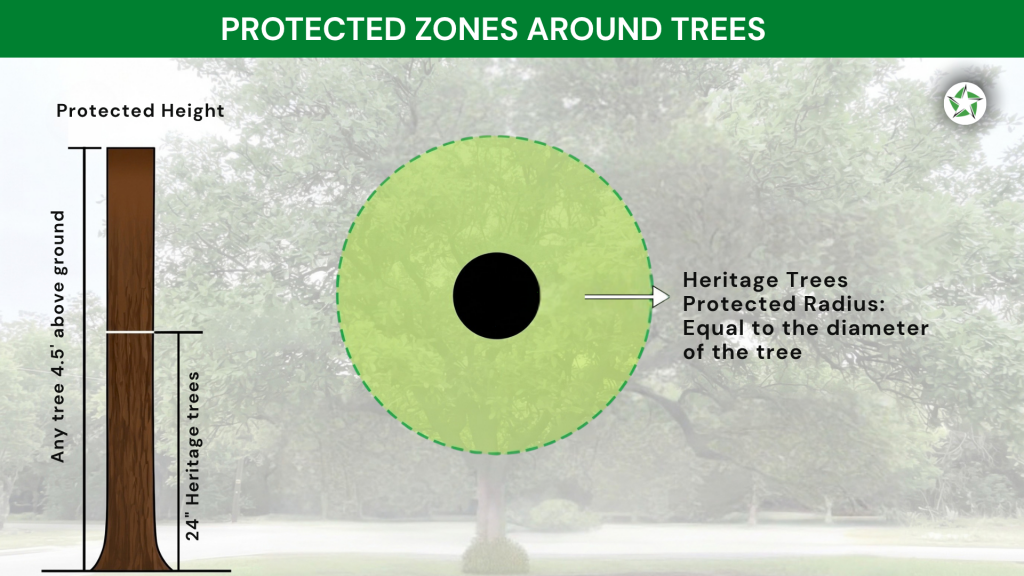
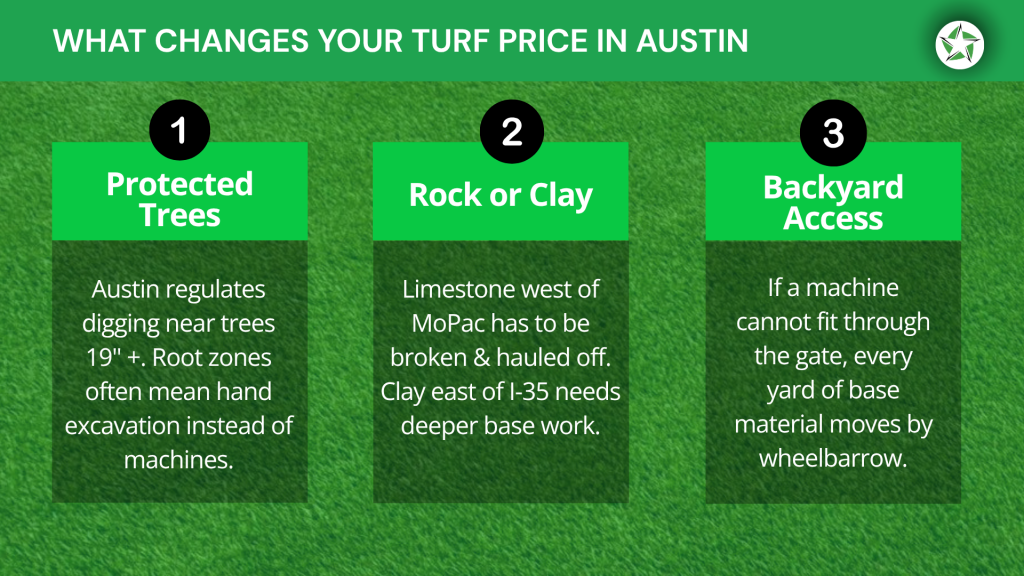
This is the one almost nobody tells you about before the estimate. Under the City of Austin tree ordinance, any tree 19 inches or more in diameter, measured at four and a half feet up, is a protected tree. At 24 inches and up, species including live oak, pecan, cedar elm, and bald cypress become heritage trees with tighter rules. The city’s own guidance spells out what counts as an impact, and soil compaction from equipment and changes to grade are both on the list.
That matters for turf, because a proper install is excavation, grading, and compaction. All three happen inside a critical root zone that extends outward roughly one foot for every inch of trunk diameter. A 30-inch live oak has a protected zone reaching about 30 feet from the trunk in every direction.
In Tarrytown, Barton Hills, Travis Heights, Hyde Park, and most of the older central neighborhoods, mature live oaks clear those thresholds easily. The practical result is hand excavation instead of machine work, adjusted base depth inside the root zone, and sometimes a Tree Ordinance Review Application before anything starts. It is more labor and it shows up in the price.
If a turf company quotes your tree-covered central Austin yard at the same rate as a flat lot in Buda without walking the property, that is worth a question.
2. Rock on One Side of Town, Clay on the Other
West of MoPac and out toward Bee Cave, Lakeway, and Dripping Springs, limestone and caliche often sit close to the surface. Excavating two to four inches of base depth can mean breaking rock and hauling it off, which is equipment time and disposal cost.
East of I-35, you are more often into deep Blackland Prairie clay, which digs easily but moves with moisture. That shifts the work toward base depth and compaction rather than rock removal. Different problem, different line item, and it is one reason a single citywide price per square foot does not hold up.
3. Whether a Machine Can Reach Your Backyard
Central Austin lots are narrow. A 78704 bungalow with a four-foot side gate means every yard of base material and every roll of turf moves by wheelbarrow and by hand, and the spoil comes out the same way. That can add meaningfully to labor on an otherwise simple yard.
Newer subdivisions in Circle C, Avery Ranch, and Steiner Ranch usually have access to bring equipment around back, which brings the labor line down.
What Else Raises or Lowers Your Quote
Pushes the price up
- Tight curves, slopes, and complex shapes that increase cutting and seaming
- Premium turf, antimicrobial infill, or pet-specific systems
- Design work layered in, like pavers, lighting, or a putting green
Brings the price down
- Open, flat, rectangular areas with straightforward cuts
- Standard family and pet turf rather than specialty product
- Minimal cutting and seaming
- Larger square footage, which spreads mobilization cost across more area
None of this replaces a walkthrough. It does tell you whether the number you are being quoted is in the right neighborhood.
What About HOAs in Austin?
Most Austin-area HOAs allow artificial turf, and many master-planned communities now encourage it given watering restrictions. What varies is the spec. Blade height, color, and pile density all show up in architectural guidelines, and a few communities restrict turf in front yards while allowing it behind the house.
We provide HOA-friendly spec sheets and help homeowners through approval. Worth starting that conversation before you schedule an install date rather than after.
What’s Included in a Lone Star Turf Installation
When you compare quotes, compare what is in them. Ours include:
- Excavation and proper base prep
- High-performance, pet-safe turf
- Antimicrobial Envirofill infill
- Durable steel or concrete edging (no cheap bender board)
- Up to 16-year warranty on turf and labor
- Professionally trained crews
Financing is available if you would rather spread the project across monthly payments. Ask your estimator for more details.
Be Careful With $4 to $7 Per Square Foot Pricing
You will see those numbers advertised for artificial turf. However, here are some common issues that come with it:
- Thin base prep, or turf laid over existing soil
- Low-grade white-labeled turf with no lab testing behind it
- Sand or crumb rubber infill
- Bender board edging that warps in Texas heat
- No license, no insurance, and a warranty that means nothing
A turf lawn is mostly what is underneath it. The cheapest quote is usually the most expensive one once you pay to have it redone.
Artificial Turf vs. Natural Grass: The Long-Term Math
Turf costs more on day one. Here is how it compares against what an Austin lawn costs to keep alive over 15 years.
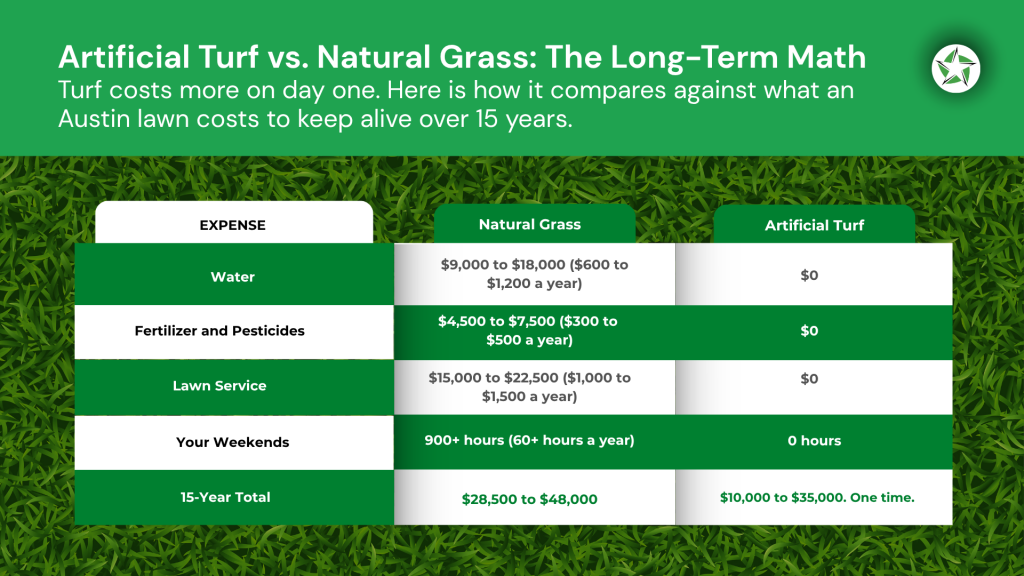
Most Austin homeowners reach break-even around year four. Water costs in particular keep climbing, so the gap widens from there. Here’s how it compares over a 10-15 year period:
|
Expense |
Natural Grass | Artificial Turf |
|
Water |
$12,000 – $24,000 | $0 |
|
Fertilizer / Pesticides |
$6,000 – $9,000 |
$0 |
| Lawn Care Services | $20,000 – $30,000 |
$0 |
| Your Time | 60+ hrs / year |
0 hrs / year |
| Total | $38,000 – $63,000+ |
$10,000 – $35,000+ |
Why Austin Homeowners Choose Lone Star Turf
We are family-owned, based in Lakeway, and we have been installing across Central Texas for years. What local homeowners and pool builders tell us matters:
- Transparent pricing and an honest read on whether turf suits your yard
- Up to a 16-year warranty on turf and installation labor
- A 5.0 Google rating across 248+ reviews
- Preferred vendor for Cody Pools and Premier Pools
- Estimators who walk your property
Read what past clients say on our reviews page, or see recent work in the gallery.

Get a Real Number for Your Austin Yard
Every quote we write starts with someone standing in your yard, looking at your trees, your access, and what is under the grass. Schedule an estimate and we will give you a real number. If turf is not right for your space, we will tell you that instead.
You can also see everything we do locally on our Austin artificial turf installation page.
Austin Turf Cost FAQs
How much does artificial turf cost in Austin?
Installed cost runs $10 to $25 or more per square foot. Most residential projects land in the $15 to $24 mid-tier range, which puts a typical 1,000 square foot backyard between $15,000 and $24,000.
Why is turf more expensive in some Austin neighborhoods?
Three local factors. Work near protected and heritage trees is regulated and often requires hand excavation. Yards west of MoPac frequently hit limestone that has to be broken and hauled. Narrow central Austin lots mean materials move by wheelbarrow rather than machine.
Do I need a permit to install turf near a tree in Austin?
It depends on the tree. Trees under 19 inches in diameter are not regulated on residential property. Larger trees are, and excavation or grading inside the critical root zone may require a Tree Ordinance Review Application. We flag this during the walkthrough so it does not surface mid-project.
Does my Austin HOA allow artificial turf?
Most do. Guidelines commonly specify blade height, color, and density, and some restrict front-yard installation. We provide spec sheets for approval submissions.
How long does an Austin turf installation take?
Most projects run one to three days. Rock excavation, tree ordinance requirements, or restricted access can extend that.
Does turf save money compared to a natural lawn?
Over time, yes. Break-even is usually around four years once you account for water, fertilizer, and lawn service, and the gap widens after that as water rates rise.
Explore More Turf Resources:
- Artificial Turf FAQs
- Pet-Friendly Turf in Austin
- Guide for Turf Putting Greens
- Guide for Turf in Public and Commercial Spaces
For a full breakdown of turf types, installation tips, and maintenance advice, visit our Ultimate Guide to Artificial Turf.