
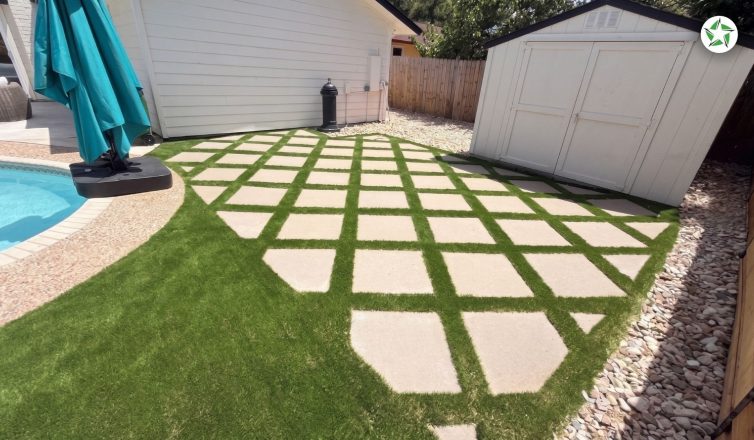
How many times have you stood at the back door, looking at that patch of lawn that won’t grow? Or how about the corner that turns to mud after every rain? If your yard takes over your whole Saturday with mowing, edging, watering, fertilizing, and pulling weeds, it might just be time for artificial turf.
If you need help getting inspired with artificial turf backyard ideas, here are five incredible projects from Lone Star Turf, each shown before and after. As you look through, consider where your backyard problem areas are, how you use the space now, and how you want to use it. Then think about the look you’re going for and how you want to feel when you spend time out there.
Each section covers what the photos show, what the space makes possible, and what to think about before you build. If you want the bigger picture first for how the process for artificial turf works, our Ultimate Guide to Artificial Turf covers it start to finish.
Give the Problem Corner a Purpose
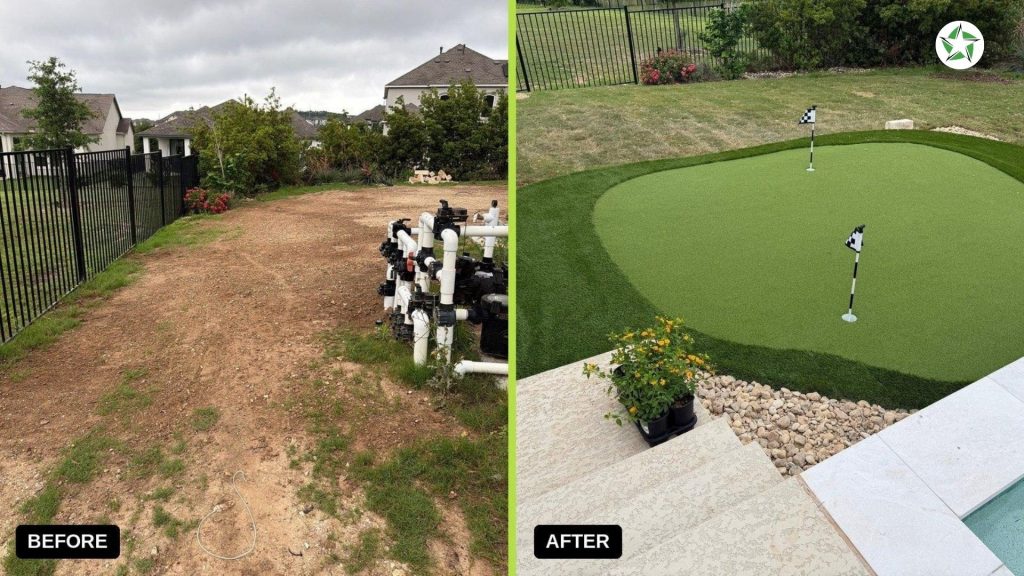
Picture standing at the edge of the pool, looking at this. Bare red dirt and a few thin patches of grass, with the pool equipment out in the open. The pool was the big investment, and this corner’s the part you avoid looking at. It’s dust in August and mud after every rain, and the red footprints end up on the deck.
Now, a curved putting green sits right beside the pool, with a darker band of turf around the edge and a river rock border where the turf ends. That corner’s the first place you walk to on a Saturday, putter in hand. It looks the same in July as it does in April, and there’s no dirt (or mud) to deal with.
If you’re considering artificial turf in your backyard, it’s best to start with the look. A curved outline looks planned, while a rectangle dropped into a yard can sometimes look like an afterthought. A darker band frames a lighter green, and a rock border gives the edge a clean line where turf meets soil. Consider where you’ll see it from most, usually the back door or the pool deck. See our putting green installs for more inspiration to bring the short game to your backyard.
Here’s what shapes how a backyard putting green looks:
- Water movement. We pack down the base under the turf and set a slight slope, so rain and pool splash keep moving the way they always did. You can’t see that work once the turf is down.
- Sun and shade. Penn State’s Center for Sports Surface Research has measured synthetic turf running hotter than natural grass in direct sun. Consider how much shade your spot gets, since bare feet will notice.
- Access. We can leave a clear path to the pool equipment, so consider how you’ll get to it.
- Upkeep. A stiff broom every few weeks keeps the busiest paths standing up.
Make the Side Yard a Place to Gather
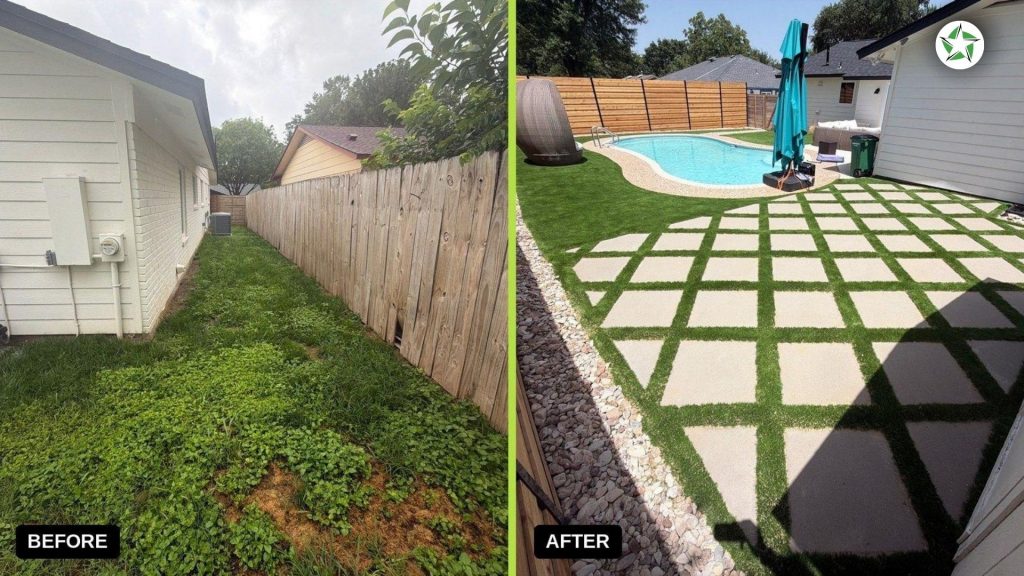
Plenty of yards have a strip like this one. It’s a narrow side yard between the house and the fence, walked through and never used. Weeds fill in where the grass gives up, and a bare patch of dirt shows through. Nobody sits out there, and nobody stays. It’s the route to somewhere else.
Now, large square pavers sit in a tight grid, with strips of turf between them and a river rock border along the fence. The same strip has a job. A space you used to walk through becomes a place to stop. Here are a few ways people use artificial turf in their backyards:
- Yard games. Cornhole and ladder toss need room to throw, and a level paver run gives it to you.
- A fire pit. A fire pit with a couple of chairs turns the strip into an evening spot.
- Seating. A small table and chairs give you a place to sit away from the main patio.
The pattern sets the look. Even spacing makes a narrow space look planned, and a grid can run square to the house or turn on a diagonal to make the space feel wider. Larger pavers give a cleaner, simpler look, and smaller ones add detail. We can cut turf around pavers you already have, or plan it together with new pavers in one project.
Before you build, settle how you’ll use the space and what goes underneath it:
- Use. The use shapes the layout, since games need room to move and a fire pit needs clearance from the turf. Consider where you’d put each one.
- What’s underneath. Pavers and turf both sit on a packed base, and a side yard between a house wall and a fence needs a path for water to move. We build both into the plan.
Give a Big Lawn Some Direction
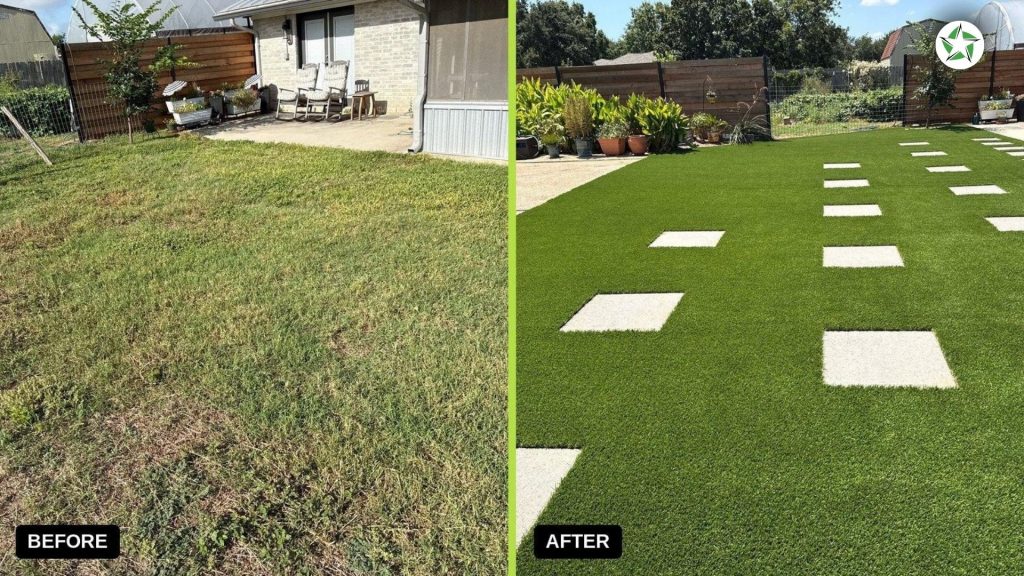
A lawn this size is a lot of yard to keep up. In the before photo it’s gone thin and patchy, with weeds coming through and worn spots where people cross it. It already gets mowed, watered, and fed, and it still looks tired. A big stretch of open grass can also feel like a lot of nothing, one surface with no sense of where to go.
Now the whole backyard is one continuous turf lawn, with square pavers set in loose lines that lead from the pool deck toward the house. Planters and potted plants line the fence. The yard looks the same from edge to edge, and nobody mows it.
A vast yard is a good place to be bold. Several stepping stones across the lawn give the space an artful, purposeful look, and square pavers on green read modern. They also solve a practical problem. When there’s more than one way across the yard, each route can have its own line of stones. Pool to patio and patio to gate can each get a path, and the lawn reads as designed rather than open.
What goes into a backyard turf layout like this:
- Stone placement. We set stones along the routes you already walk and space them for an easy stride.
- A level finish. The stones sit even with the turf, so feet and wheelbarrows don’t catch.
- Sun. A big open lawn gets a lot of direct sun, so consider where shade falls.
- Wear. The busiest lanes flatten around month four or five, and a stiff broom stands them back up.
Make Your Pool Area Feel Like an Oasis
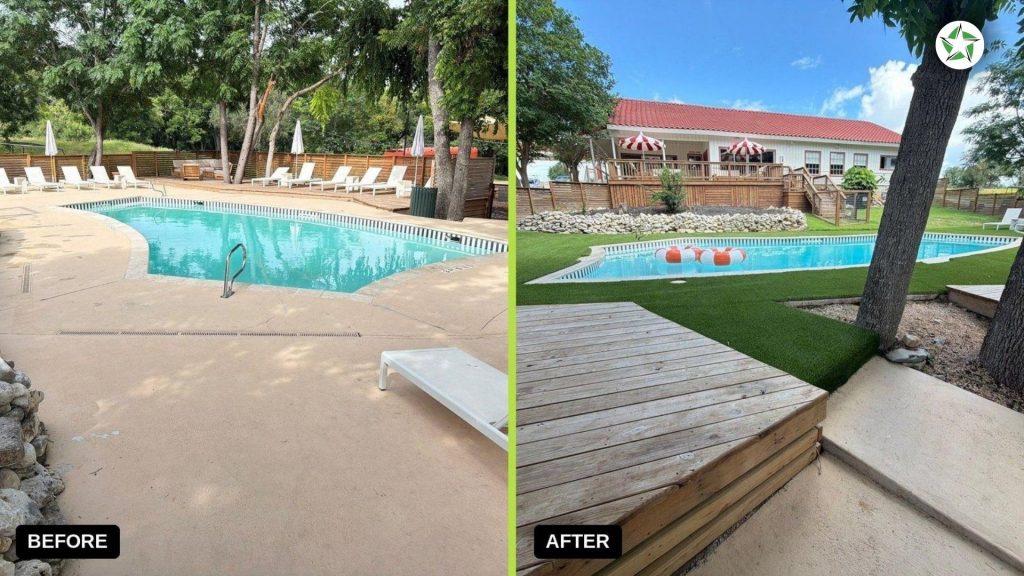
In the before photo, a concrete deck wraps the pool. Lounge chairs sit out on bare slab with a rock wall behind them. The space is usable, but it’s all hard surface, with nowhere green to sit or let kids run.
Now one stretch of turf ties the property together. A wide pool sits beside wood decks, the rock garden wall, lounge chairs, and several mature trees, with green running between all of it. Turf around a pool gives the space an oasis feel. It softens what’s usually all hard surface and makes the whole area feel calmer and more relaxed.
Pool areas have room for more ideas than one lawn:
- A lounge strip. A stretch of turf beside the water gives you something softer than concrete to stretch out on.
- A kids’ play zone. Turf set back from the deck gives kids a spot to run away from the pool edge.
- A shaded seating corner. Under the trees, a seating area on turf feels like a retreat.
Where turf meets something else matters here. This yard has deck boards, pool coping, a rock wall, and tree trunks, and each one needs a clean line. The turf stops short of the trunks and leaves open ground around each tree, so the trees keep their space. More to consider around a pool:
- Leaves. Mature trees shed debris, and a leaf blower clears it in a few minutes.
- Sun. Turf runs warmer than natural grass in direct sun, so consider which parts of the property get afternoon sun.
- Water movement. Splash and wet feet need a path through the surface, and the base under the turf is built for that.
Our pool turf page covers how turf compares to pavers and concrete around a deck.
Add a Turf Zone to a Lawn You Already Love
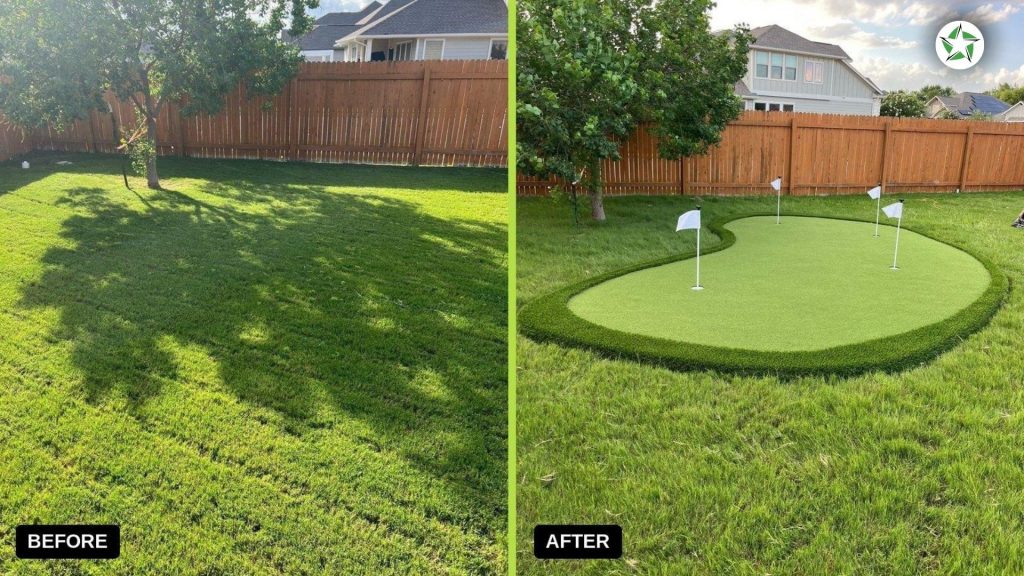
The before photo is a lawn most people would be proud of. Thick green grass, a shade tree, a wood fence, and nothing that needs fixing.
Now a kidney-shaped putting green sits in that same fenced backyard, with a tight band of turf around the edge and three flags on the cups. The grass around it stays, and the green looks right at home beside it. The yard didn’t have to pick one surface. You keep the lawn you love and add a spot to practice your short game.
That mix is the idea to steal. A yard doesn’t have to be all turf to get the benefit, and a small zone can cover the spot that gives you the most trouble or give the yard a new use. Here are five places one can go:
- Under a swing set. Grass wears out first where kids play, and turf holds up to the traffic.
- Along the fence. It gives a dog a run with no mud.
- In a shady corner. It covers the patch under a tree where grass never takes.
- Beside the patio. It can carry a seating area or a fire pit pad on pavers.
- In the middle of the lawn. A bocce court or chipping area works the way the green does here.
Here’s what shapes a zone like this:
- A level base. A putting surface needs a firm, level base for a true roll, with a path for water to move through.
- The edge. Where turf meets natural lawn needs a clean line, which keeps grass from creeping onto the turf.
- Nearby trees. Roots can shift a base over time, so we plan around them.
Our residential turf page covers installation start to finish.
Four Artificial Turf Ideas to Take Into Your Own Backyard
These five yards share four ideas:
- Every square foot has a job. Turf covers the open areas, hard surfaces like pavers and decks handle the walking, and rock or planting finishes the edges.
- Edges are planned. Curves, borders, and rock lines show where one material ends and the next begins. That keeps a turf yard from looking rolled out.
- Turf works around what’s already there. Pools, decks, pavers, fences, and mature trees all show up in these photos.
- The work you can’t see holds it together. We strip out the old grass and roots, pack down a layer of decomposed granite, which is a fine crushed stone, and set a slight slope so water keeps moving the way it always did. A photo never shows that part, but it keeps the surface even. If you’re comparing installers, it’s a fair question to ask each one.
Frequently Asked Questions: Artificial Turf Backyard Ideas
Can turf be installed around pavers, a pool, or decking?
Yes. We can cut turf around existing pavers, pool coping, and decking, or plan it together with new pavers in one project.
How is a putting green different from regular turf?
A putting green uses a shorter, denser surface built for a true roll, usually with a darker band of turf around the edge.
Does turf work in yards with mature trees?
Yes, with planning. We leave the trees room and prep the base so the surface stays even. We look at this on every estimate.
What does a project like these cost?
Square footage, how much prep the site needs, water movement, and extras like pavers or a putting green set the price. Our turf pricing page explains what moves the number up or down.
Get Your Free Artificial Turf Estimate
If one of these layouts looks like your yard, we’ll tell you whether turf makes sense for it. Not every yard needs turf. If grass works for your space, we’ll tell you.
Your install carries up to a 25-year warranty. Get a free estimate, and we’ll walk your space with you, or browse more finished projects in our gallery.