
Nobody wants to be the person who ruined a brand new artificial turf lawn with the wrong bottle from under the sink. It is one of the first things homeowners ask us after an install, usually some version of: So how do I maintain artificial turf? What am I allowed to spray on this?
Here is the reassuring part: the list of things that damage turf is short, and every item on it is easy to avoid. Artificial turf is low maintenance (not zero maintenance) and the gap between those two comes down to about ten minutes of attention a couple of times per month. This is what it takes to maintain artificial turf so it stays looking like installation day fifteen years down the road.
What It Takes to Maintain Artificial Turf
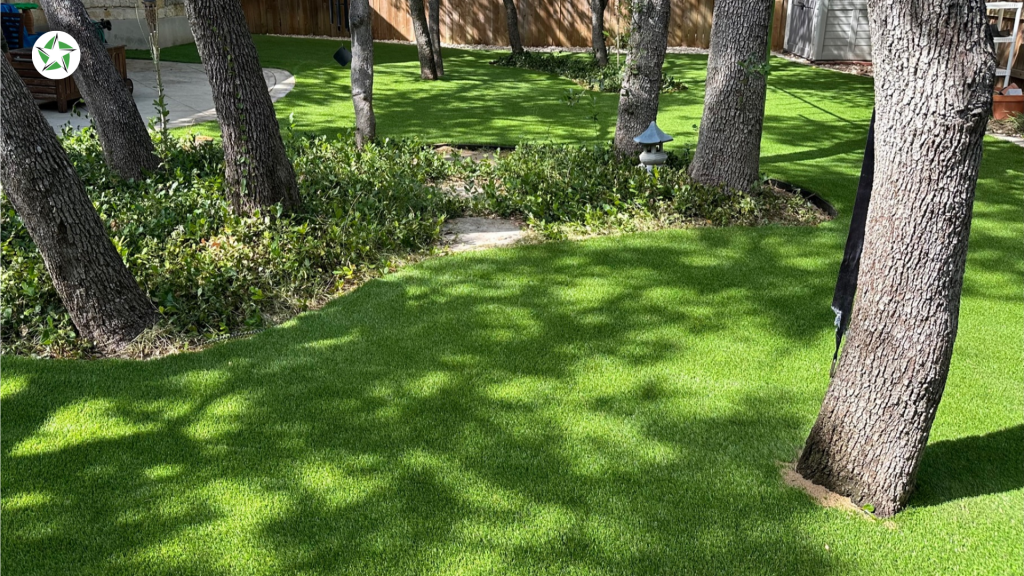
Four jobs cover almost everything: rinsing, clearing debris, brushing the fibers, and checking on your infill. The Synthetic Turf Council guidelines name the same core set for professional installations, which is a decent sign you are not missing a secret fifth step.
What disappears with turf is the heavy lifting: there is no mowing, your sprinkler system does not need to reach it, nothing gets fertilized, aerated, or reseeded when the grass thins out in October. You trade a little upkeep for a lot of weekends back, and that upkeep is what guarantees turf has the longest lifespan possible.
The Routine, and Why It Is Shorter Than You Think
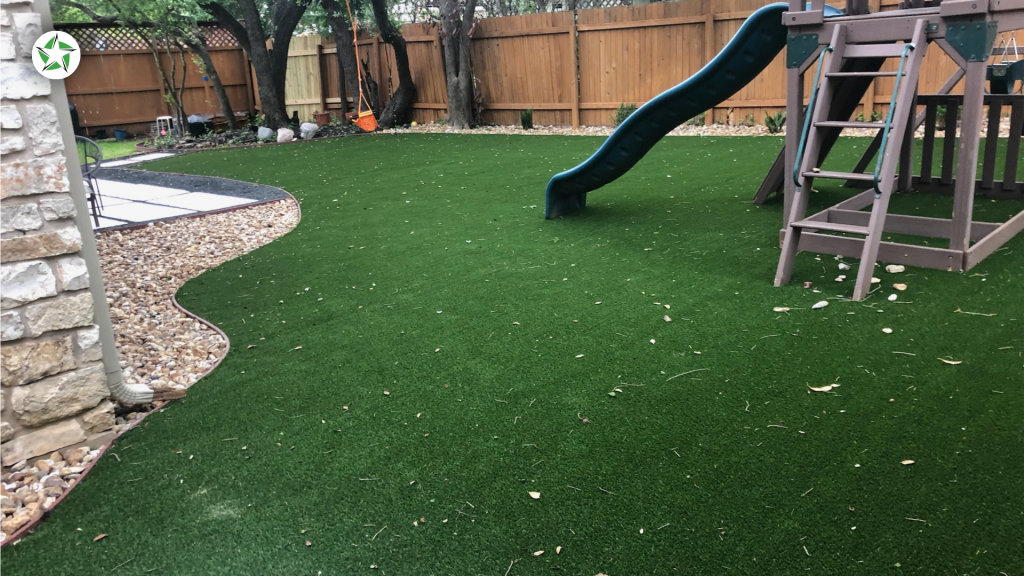
To maintain artificial turf, a rinse handles more than people expect. Once or twice a month, walk the yard with a hose and wet the whole surface down. Dust, pollen, and the fine grit that blows off Hill Country limestone all move straight through the backing. Cedar season and long dry stretches earn an extra pass. A standard garden nozzle gives you plenty of pressure.
For leaves and twigs, a leaf blower on a medium setting works fast. Angle it across the surface rather than straight down, so you move debris without moving infill. When something heavier lands, like a branch after a storm, reach for a plastic rake.
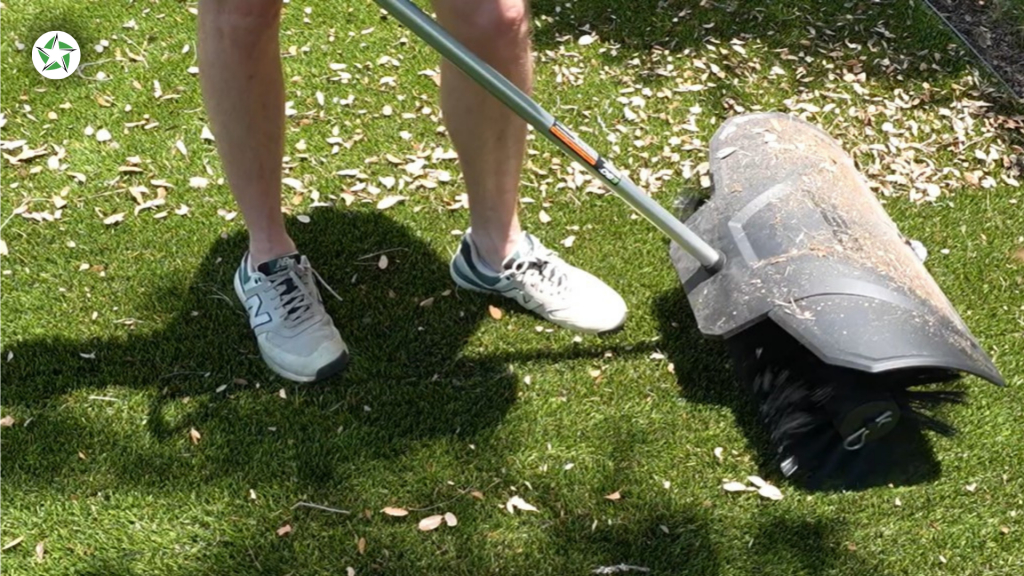
Brushing does the most good for the least effort. Grab a stiff push broom with nylon or poly bristles and work against the direction the blades lean. That lifts fibers flattened by foot traffic and spreads infill back where it belongs. You only need to hit the lanes people use, which in most yards means a strip from the back door out to wherever the dog goes (every three or four weeks keeps things looking full).
Pet Cleanup, in the Right Order
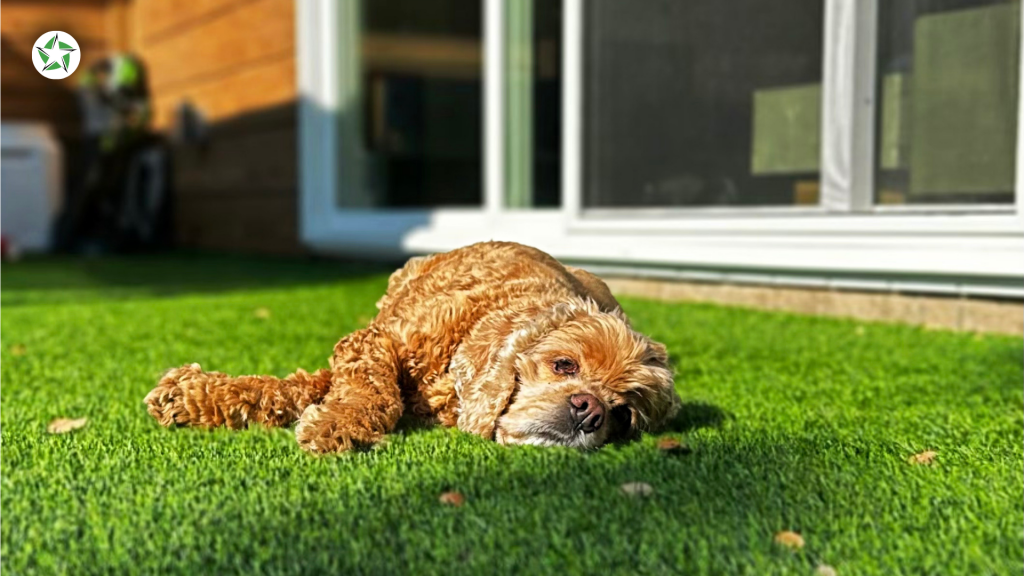
Solids come up the same way they would on real grass. Scoop first, then rinse the spot.
Odor is where technique matters. Rinsing dilutes what sits on the surface, but urine also leaves uric acid behind, and uric acid does not dissolve in water. That is why a smell can seem handled and then turn up again on the first humid morning. An enzyme cleaner fixes it by breaking the uric acid down instead of washing over it. Saturate the area, give it ten or fifteen minutes to work, and resist the urge to hose it off right away.
Bleach and vinegar are the two most common wrong answers to maintaining artificial turf. Neither touches uric acid, and bleach can lighten fibers if it sits. Our guide to fake grass for pets goes deeper on odor control, and the pet turf page covers the backing and infill choices that make a heavy-dog yard easier to keep fresh from day one.
Spills, Sunscreen, and Whatever the Party Left Behind
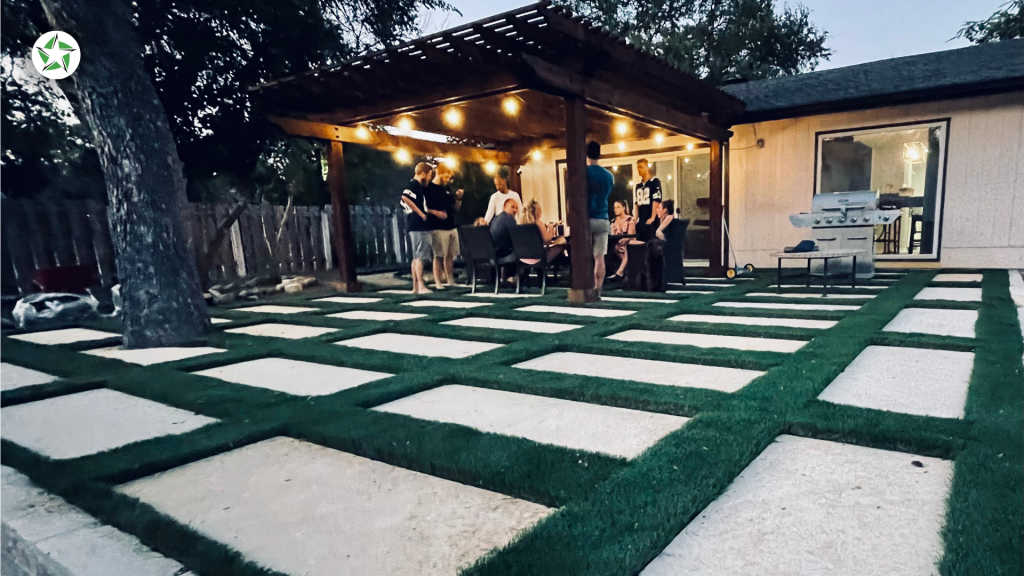
Almost every household spill comes out with warm water, a few drops of dish soap, and a soft brush. Blot anything greasy before you scrub, since spreading sunscreen or barbecue drippings around only makes a bigger job of it. Work from the outside of the spot inward, then rinse.
Gum and candle wax behave differently. Chill them with an ice cube until they harden, then lift the piece straight off. Tree sap gives in to the same trick.
On well water or hard municipal water, you might notice a faint mineral film after a lot of rinsing in full sun. Rinsing in the morning or the evening keeps that from setting. As for the occasional weed, it is not growing through your turf. It sprouted in the thin layer of dust sitting on top, so pulling it by hand is the whole fix.
The Short List of Things That Damage Turf
Pressure washers account for most of the damage we get called out to look at. A narrow jet held close strips infill in seconds and can work fibers loose from the backing. If you own one and want to use it, switch to the widest fan tip, drop the pressure, and stay a full arm’s length back. A garden hose does the same job with none of the risk.
Metal rakes and wire brushes are the other easy mistake, because they tear fibers rather than lifting them. Stiff bristles are fine as long as they are plastic or nylon.
Solvents belong nowhere near turf. Acetone, paint thinner, gasoline, and pool chlorine tablets left sitting on the surface all qualify. If any of it spills, rinse fast.
Heat gets more worry than it deserves, with one exception. Penn State’s Center for Sports Surface Research has measured synthetic surfaces running 35 to 55 degrees hotter than natural grass on a sunny day. Warm underfoot, yes, but nowhere close to the temperature that softens turf fiber. A melted spot almost always traces back to something concentrating heat in one place: a grill parked too close, a fire pit with no barrier under it, a dropped cigarette, or afternoon sun bouncing off a low-E window onto the same patch every day. Pavers under the grill and a stone pad beneath the fire pit take care of the first two.
When It Is Worth Calling a Crew
A few things should not fall to you on a Saturday. Infill compacts down over the years in busy areas. Traffic lanes eventually stop springing back from hand brushing. Seams can lift along an edge, and a yard with several big dogs may hold onto odor no matter how solid the routine is.
A power broom and a deep clean reset all of that, and it lands as a service call instead of a project. Our turf cleaning and maintenance page covers what a visit includes. Most yards do fine with one a year, and heavy pet yards get more out of two.
.
Frequently Asked Questions: How to Clean and Maintain Artificial Turf
How often do I need to clean artificial turf?
A rinse and a debris clear once or twice a month suits most yards. Brush your traffic lanes every three or four weeks. Pet areas want rinsing more often than that, plus enzyme cleaner as needed.
Can I pressure wash artificial turf?
Carefully, yes. Use the widest fan tip at the lowest pressure and keep the wand an arm’s length off the surface. A close, narrow jet blows infill out and loosens fibers. A hose is safer and usually plenty.
What cleaner is safe to use on artificial turf?
Mild dish soap and water for general messes. An enzyme cleaner made for turf or pet areas for odor. Skip bleach, vinegar, solvents, and anything sold for killing weeds or dissolving oil.
Will I ever need to add infill?
Occasionally. Infill migrates and compacts with use, mostly in the spots that get walked on daily. A crew can measure the depth during a maintenance visit and top it off if it has thinned out.
Does pet odor build up over the years?
Not when an enzyme cleaner is part of the rotation, since the uric acid gets broken down rather than rinsed around. Turf built for pets, with the right backing and infill underneath, makes it easier still.
Can artificial turf be installed around existing pavers or concrete?
Yes. Turf can be cut and fitted around pavers, coping, or existing concrete without tearing out everything already there. It’s one of the most requested combinations we install.
Get Your Free Estimate
Keeping turf clean takes less work than most people picture, and most of what protects it comes down to knowing the four or five things to skip. If you have questions about a lawn you already own, or you are weighing turf and want a straight answer on how to maintain artificial turf, get a free estimate and we will walk your yard with you. The Ultimate Guide to Artificial Turf is a good next read if you want the full picture first.